

UNC6692, a newly tracked threat cluster responsible for a multistage intrusion campaign combining social engineering, a custom modular malware suite (the SNOW ecosystem), and a methodical pivot through a corporate Windows environment to fully compromise the victim’s Active Directory domain.
Every post-access phase, from initial reconnaissance to the final exfiltration of NTDS.dit, is described with technical precision, including tooling, execution methods, and infrastructure. That level of detail makes it an ideal source for building a threat-informed detection scenario on BlackNoise.
The goal is simple: translate a real, observed attack chain into an executable simulation
assume breach model. This scenario does not simulate the initial phishing phase, no Teams message, no credential harvesting page. The simulation starts from the point where the attacker already has a foothold on a Windows endpoint with local administrator privileges.
This is intentional. The value of the scenario lies in what happens after
The Threat Actor: UNC6692
What makes UNC6692 particularly relevant for detection engineering is their systematic abuse of legitimate cloud services across the entire intrusion lifecycle, payload delivery, C2 communication, and data exfiltration all ran through trusted platforms (AWS S3 buckets, a Heroku WebSocket endpoint). As GTIG notes in their report:
« By hosting malicious components on trusted cloud platforms, attackers can often bypass traditional network reputation filters and blend into the high volume of legitimate cloud traffic. »
The « Living off the Cloud » Problem
« This ‘living off the cloud’ strategy allows attackers to blend malicious operations into a high volume of encrypted, reputably sourced traffic, making detection based on domain reputation or IP blocking increasingly ineffective. Defenders must now look beyond process monitoring to gain clear visibility into browser activity and unauthorized cloud traffic. »
This observation shaped the construction of this scenario. The exfiltration event, data transferred to an attacker-controlled S3 bucket over HTTPS, is structurally identical to legitimate AWS traffic generated by hundreds of enterprise applications every day. Detecting it requires behavioral analysis on cloud egress, not signature matching.
The scenario is designed to force that question into the open:
Building the Scenario: Selection Principles
every selected event must be directly anchored in the GTIG report, either as an explicitly described action or as an immediate technical prerequisite of a documented action.
Two tiers of events were defined:
Tier 1 – Strict coverage: events directly described in the article.
Tier 2 – Extended coverage: events that are a required technical precondition for a documented action (e.g., enabling Restricted Admin mode in the registry is the direct prerequisite for Pass-The-Hash over RDP, which UNC6692 explicitly used).
The final scenario contains 14 events
Event Selection: The Link to the Source Report
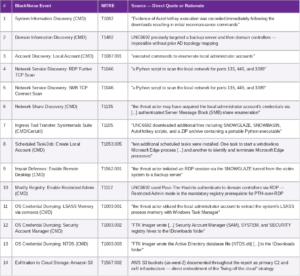
What This Scenario Tests
1. Can you detect post-compromise reconnaissance? Events 1–3 execute standard CMD commands (systeminfo, net user, nltest). These are indistinguishable from legitimate admin activity in isolation, only behavioral correlation (unusual parent process, unexpected user context) will flag them.
2. Do your network security controls catch slow internal scans? Events 4–5 use furtive TCP scan techniques with delays between requests. Signature-based detection tuned for fast scanners will miss them entirely. Detection requires flow analysis or behavioral baselines.
3. Is your registry monitoring configured for pre-PTH setup? Event 10 (Enable Restricted Admin) is a precise signal for an incoming Pass-The-Hash attack. If this registry modification goes undetected, the lateral movement to the DC will likely succeed uncontested.
4. Does your EDR flag LOLBin-based LSASS dumping? Event 11 uses comsvcs.dll MiniDump — a fully native Windows method. Detection quality here is a direct function of EDR configuration depth.
5. Can you detect domain-level credential extraction? Event 13 (NTDS dump) is the highest-severity action in the scenario. Blind spots here mean an attacker can walk out with every domain credential hash undetected.
6. Is exfiltration to cloud storage visible?
Conclusion
For Blue Teams, this scenario offers something more valuable than a generic attack simulation: a ground-truth benchmark against a known adversary. Running it reveals not only whether alerts fire, but whether the detection logic is correctly tuned for the specific challenge UNC6692 represents, an attacker who generates no suspicious domains, no known-bad IPs, and no unusual file signatures, yet manages to extract an entire Active Directory.
—–
Source for this scenario: Google Threat Intelligence Group, « UNC6692 Custom Malware »
https://cloud.google.com/blog/topics/threat-intelligence/unc6692-social-engineering-custom-malware
